


Weaving Memory, Identity, and Community Through Art
- Madelline Vicencio
- Aug 28, 2025
- 3 min read
Article by Madelline Vicencio
Born in Houston, Texas, to a Mexican mother, into a family where we did so much with so little, my imagination was fueled by the obstacles of my upbringing. I fed my appetite for creation by playing on green carpet and a green backyard, working with nubby crayons on loose-leaf paper, and spending boredom daydreaming, then drawing those dreams into comics. I decided to utilize painting and drawing as a means of processing the incomprehensible, even during stressful moments. It was in art classes where I made peace with the loss of my home caused by the notorious Houston floods and coped with the complicated condition of being born a child of immigrant parents. I used these artists, like René Magritte, Max Ernst, and Frida Kahlo, as mentors for depicting the eerie and representing vulnerability. For several years, I worked solely with acrylic on canvas and rendered figures as close to life as I could. This was before I underwent an artistic transformation while at the University of Houston.
Cut off from the social world in 2020, I finished off my final years through Zoom and created my last student paintings in the garage of my mother's home. The environment was ideal for the gnarly and abstract route my work started to take, despite the fact that it was hot, alienating, and shared housing with tiny rodent inhabitants. My attention was now drawn to the simplicity of Agnes Martin’s paintings, the chaotic disobedience of Molly Zuckerman-Hartung, and the craftsmanship of Sonya Clark. I tied this style of push/pull, deconstruction/reconstruction, and ugly/beautiful to the feeling of belonging, specifically to a place where I am accepted, regardless of where I was born and where my blood ties lie.

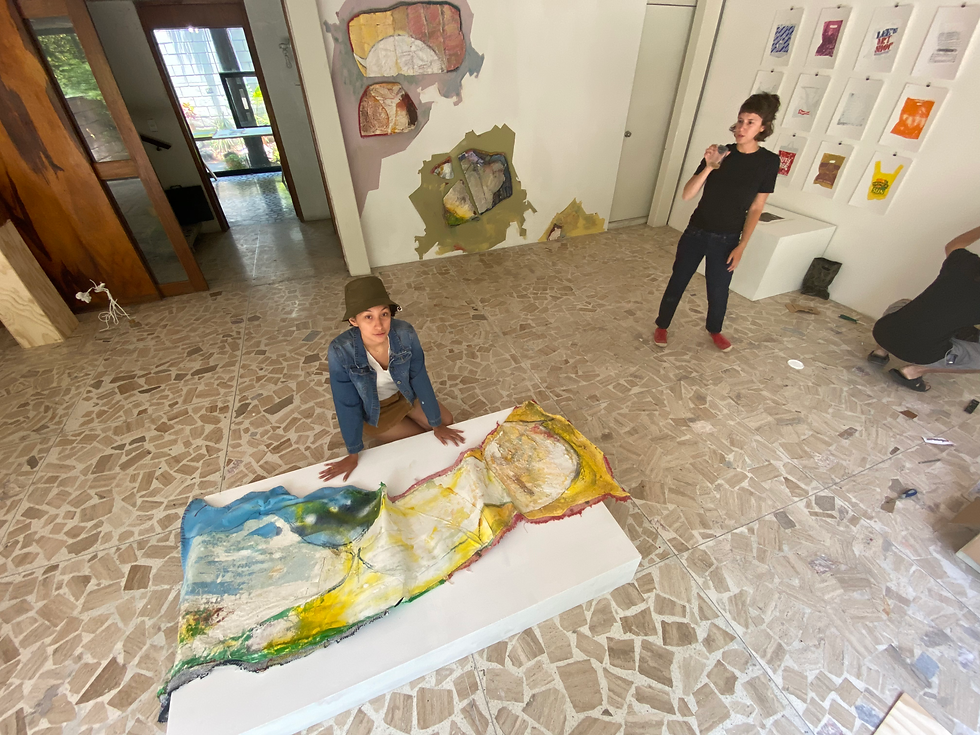
After graduation, I attended a residency in Mexico City at Casa Lü, where I felt a strong connection to the objects in my mother's homeland. I observed a deep emotional charge in the way that people value both cherished belongings and discarded treasures. I’ve learned that these attachments reveal the complexity of memory, identity, and love. As a result, I installed a wall and pedestal piece that projects a "dreamland" bridging my relationship between Texas and Mexico. I decided to use repurposed materials, some of which alluded to waste from consumerist products and Mexican cleaning supplies. Serving to distinguish a touch of affection to a piece, I impulsively added embellishments such as textile weavings, paper pulp, needlework, and crochet. Instead of strictly working with acrylic, I mixed pigment with plaster and explored the opaqueness of gouache.
Following Casa Lü, I returned to Mexico on my next residency at TEXERE, located in Oaxaca, MX, where I worked primarily with fibers. I learned how to use a floor and table loom and hosted my very first community event. Community engagement has also become an important and recurring theme in my practice. It is my advice to young artists to interact with their peers, viewers, and the artistically curious. Your art is half the work needed to bring your vision to life. Go to art openings, go to open studios, take workshops, and meet your community. The conversations you have about the experience of art making and, specifically, about what you are trying to portray in your work will illuminate, validate, and spread the message you are telling the world. My warning is to be consistent about it, and you cannot let the fear of socializing take this away from you. Every third Monday of the month, I host a free collage workshop in Houston. I have met with all levels of makers, some swearing they do not have a creative bone in their bodies. However, when leaving the studio, my new friends never fail to feel empowered by making things with their hands and building connections with like-minded people. Social engagement matters so much to the people around me, and especially to the way I experiment with making.

Currently, my projects begin with a search for natural fibers, thrifted goods, or trash accumulated at home. This collection of scattered items relates to my extensive material research, where I preserve with the intention of documentation. Ruminating on the word “documentation” raises questions about who gets to be documented and how people document themselves. Whether these materials come from the “immigrant clutter” of my mother’s home or trash gathered during morning strolls, these objects serve as a capsule for the individual or community under investigation. In all my work, whether through fibers, found objects, or community interaction, I aim to honor the resilience embedded in everyday things. My practice continues to evolve as both a personal and collective archive. By preserving what is often overlooked, I seek to affirm the lives, cultures, and histories of those who persist against erasure.
Website: mvicencio.com
IG: @madellinevice


