


Mapping the Complexity of Emotion Through Motion and Form
- Baron Hill
- Mar 30
- 6 min read
Interview with Baron Hill
Please tell us something about your background and your art journey so far.
If you had to know anything about me to better understand my work, simply put, I find emotions to be complicated at times. While that might seem like a simple thing to acknowledge—because, yeah, we’re complicated beings—I also say that in correlation with my experiences of not always being able to understand other people’s emotions very well.
I’ve had social anxiety for the latter half of my life, not to mention my own struggles with understanding how to act in conversations and social settings, often sticking out like a sore thumb in a room full of “regular people.” Being the overthinker I am, I took everything people gave me into account and analyzed the hell out of it until I exhausted myself: “Why didn’t they respond to my joke?” “What’s with that weird look?” “Do they not like me? They were laughing and being respectful before…”—things like that.
To be honest, it became a real challenge. Trying to make friends—even in high school—became hard, and talking to girls even harder. This often left me with emotions I didn’t necessarily know how to label as good or bad (anger, fear, guilt, regret, etc.), leading to even more confusion and frustration in a body I didn’t have a manual for.
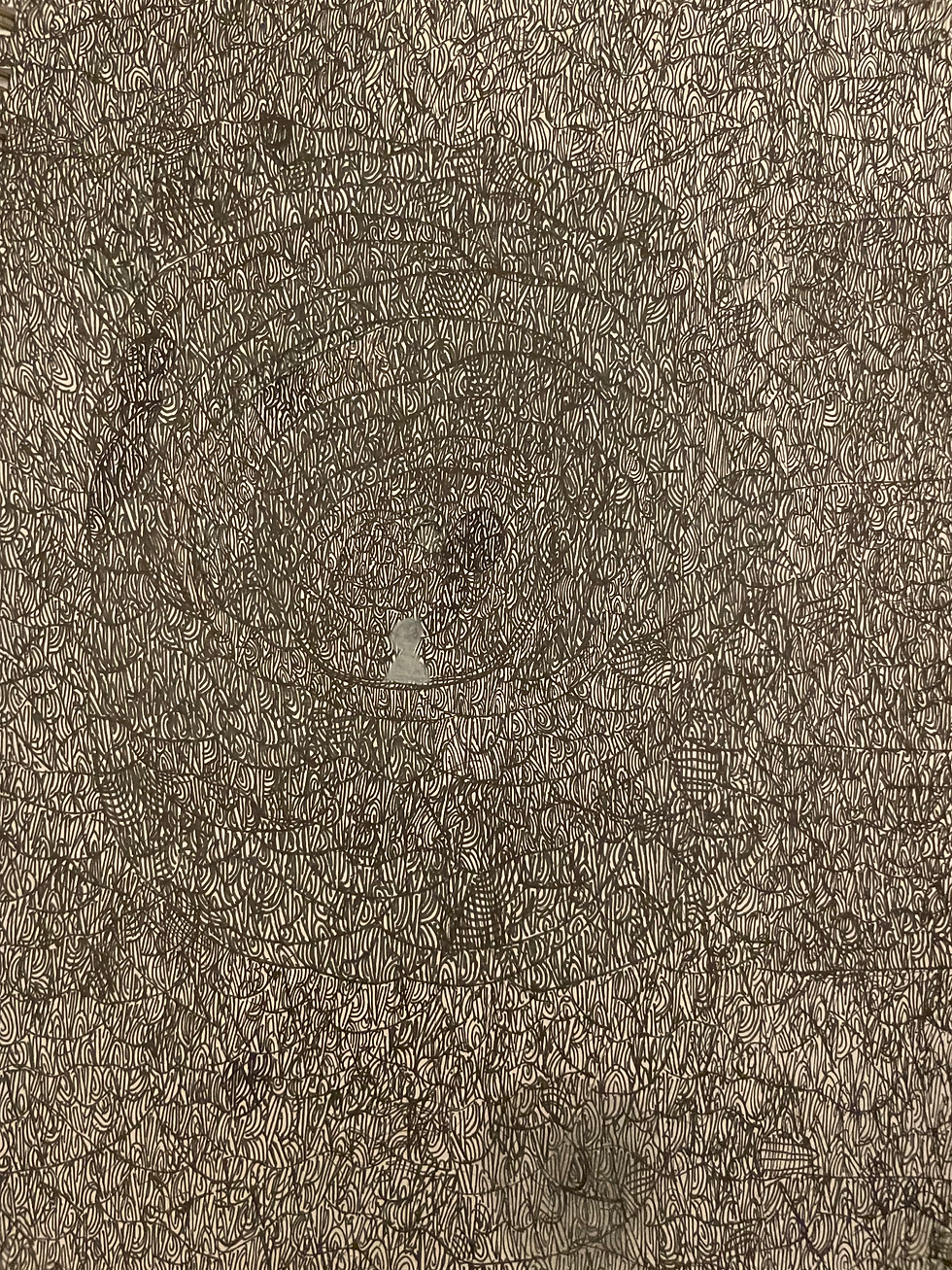
That’s why I work in the style that I do: to capture these complex, ever-moving emotions built up from past experiences and to help others who struggle to understand their emotions as well.
As of now, my journey is moving at an admittedly modest yet stable pace. While I don’t have a large following across all of my accounts yet, I’ve built a fanbase on platforms like Instagram (509 followers), have already done interviews with places like Al-Tiba9, and have been featured in smaller galleries such as the Domio Gallery. So far, I’ve gained some traction, but in order to bring my message to larger audiences, I still have a long way to go.
Describe what a normal day looks like as an artist.
Since I’m a student still enrolled in high school, most of my day revolves around my studies while I try to sneak in practice whenever I can. I’m taking three AP classes, but surprisingly I usually have time—mainly during lunch. If I happen to finish my work early for the day, I’ll also use class time to work on new, smaller pieces or other projects I want to focus on in my artistic journey.
When I get home at around 4–4:30, it depends. Again, with three AP classes there’s sometimes leeway, but not always because of the workload. When I do have time, though, I’ll play one of my many playlists—what I listen to really depends on my mood. I like piano pieces, breakbeat, and similar music. That’s when I start creating more extensively.
I usually work on one of my larger projects or post a work in progress if I have a piece halfway done. Then I’ll keep working for the rest of the night while balancing schoolwork, breaks, working out, and other responsibilities.

Can you tell us more about the theme in your art and your inspiration?
So, kind of like I said before, my art is based on the idea of complex emotions. What I mean by that is that oftentimes, from what I’ve noticed not just in myself but in others, when we experience strong emotions, they don’t come out of nowhere. Anger is often layered with past moments of irritation. Sadness comes from holding back pain. Every emotion is layered with other emotions, creating a ball of confusion that’s hard to unravel.
That’s why I draw emotions using a combination of lines and arches. It not only creates a sense of an unyielding force, like emotion itself, but also gives the illusion that everything is moving. Expressing emotions this way captures their complexity and helps those who struggle to understand their feelings realize a fundamental truth: we, as human beings, are complicated. Our emotions never truly stop moving, even if it doesn’t always feel that way.
As for inspiration, I mainly derive my artistic influence from Jean-Michel Basquiat. The reason I was able to expand into the arches and lines I use today is because, when I was younger, I drew heavily from his style. My work became more chaotic and abstract, focusing on numbers, characters, anatomy, and things like that. But as I gained my footing and experimented with different patterned styles, the arches and lines were the only elements that stayed with me throughout the years. Eventually, I arrived at the foundation of what would become my art form today: the continuous, static form.
Share your worst experience in the art world.
Okay, so this one experience really got on my nerves at the time. I know a girl—an acquaintance in my class; let’s call her K for the sake of the story. She knew a family friend through one of her mom’s connections and managed to land a million-dollar art deal at a Jamaican hurricane relief art show for charity after a recent hurricane hit Jamaica—half a million for charity and half a million for her.
I asked her, “Hey, how’d you get such a great deal?”
She told me, “Oh, the guy who connected me to the show was friends with my mom. If you’d like, I can send you his number. Just say you’re friends with K.”
I thanked her, of course, and later texted him. I said, “Hey, I’m friends with K. I wanted to see if you had any opportunities for my art.” The man—let’s call him Blake—said, “Of course, young man. Just send me a few of your pieces.”
I did… and he never got back to me. That was four or five months ago, and there’s been nothing but radio silence.
I knew things like this were bound to happen, especially with my experimental art style, but this moment in particular felt like I put my pride in this man’s hands. In my head, he took one look at my pieces and thought, “Ew, this is all he can do? I’m not giving this kid a shot.”
Not to mention I even sent him a follow-up message, and there was radio silence again.
It didn’t hurt because I got rejected—I’ve been rejected many times, both inside and outside of art, and I was prepared for that. It hurt because I missed the chance to possibly push my art out there to a much bigger audience than I have now—and, hell, maybe even make some money off it.
It still sucks, even to this day. But I’ve kept pushing and trying to find other avenues to grow my craft.

Is the artist's life lonely? Please share your thoughts and experiences.
I’ve had this question for a very long time, even before this interview. I would watch videos on Instagram from many different artists, trying to make more connections on my platforms. In this process, I accidentally came across this one video—it was 15 seconds long—with a guy saying that, yes, the artist’s life is lonely.
I thought to myself, “How? I mean, I have friends, I have a family—I’m not lonely now, so what gives?” But I thought about it more, and about my current situation as a junior in high school. I have friends, but they’re not as close as I would want them to be. Conversations with them seem short and forced, and when we’re not in school, they just don’t happen often either in calls or texts.
So naturally, I spend weekends either drawing, writing, playing video games, hanging out with my mom, or doing homework in my room—all without much contact with friends. However I do get the occasional “How are you?” or a reel they send me on Instagram from time to time.
At this point, I feel more inclined to say that, yes, the life of an artist is lonely—but then again, it’s definitely not set in stone for me. I’m just a high schooler who still has family to keep me company, and all of this could change once I go to college and find myself in a much bigger crowd compared to my school of just a little over 200 people.
Instagram: https://www.instagram.com/beeeez0


