


The Space Between Us
- Daye Kim
- May 5
- 6 min read
Interview with Daye Kim
1. Please tell us something about your background and your art journey so far.
I grew up in Seoul and studied Metalsmithing and Textile at Sookmyung Women's University, which gave me a strong foundation in traditional craft. But it was when I moved to London to do my MA in Jewellery & Metal at the Royal College of Art that something shifted. I stopped thinking about jewellery as decoration and started thinking about it as a situation. A piece that requires two bodies to exist. A work that only makes sense in relation to someone else.
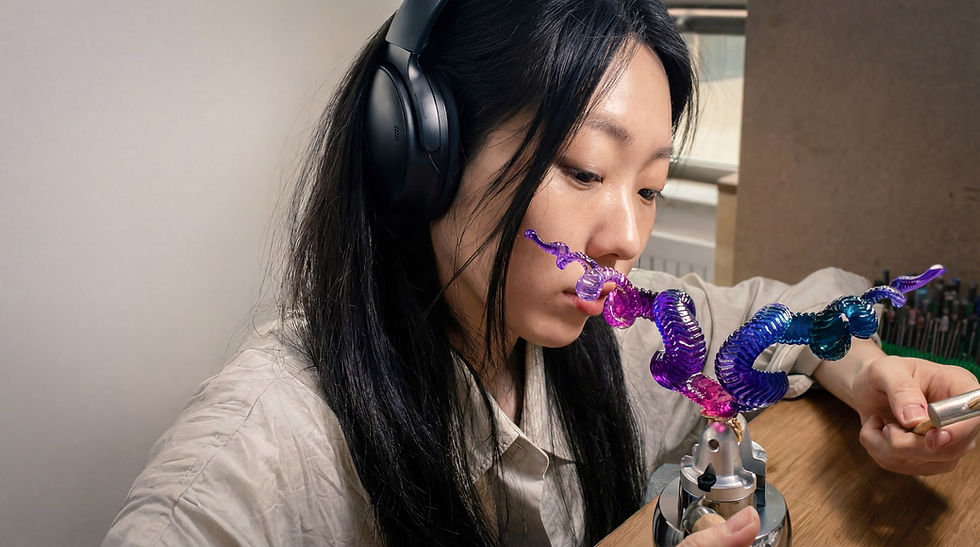
Before the RCA, I worked in visual merchandising at Tom Ford Korea, which taught me a lot about how objects communicate in space, what they say before anyone touches them. That experience quietly shaped how I think about presence and display, even now.
My practice has taken me to Munich Jewellery Week, where I was a SCHMUCK finalist, to exhibitions in Austria, Ireland, and across London during Craft Week and the Design Festival. I've received awards from the Goldsmiths' Craft & Design Council. But more than any of that, my journey has been one of learning to trust the personal, to let the most specific, private relationships I have become the subject of my work.
2. Describe what a normal day looks like as an artist.
There's no single version of a normal day, which I think is both the gift and the difficulty of this life. Some days are almost entirely at the bench, soldering, filing, going back and forth between something not working and almost working. I use a mix of traditional techniques like guilloche engraving and casting alongside digital tools like Rhino and ZBrush, so there are also days that are more screen-based, quieter in a different way.
Then there are days that feel less like being an artist and more like running a small, underfunded operation. Writing applications, coordinating international shipments, responding to emails, translating my practice into words for people who haven't seen the work. That side of things takes more time than I expected when I started. I've made peace with it mostly, but I'd be lying if I said it didn't sometimes pull me away from where I actually want to be, which is making things.

3. Can you tell us more about the theme in your art and your inspiration?
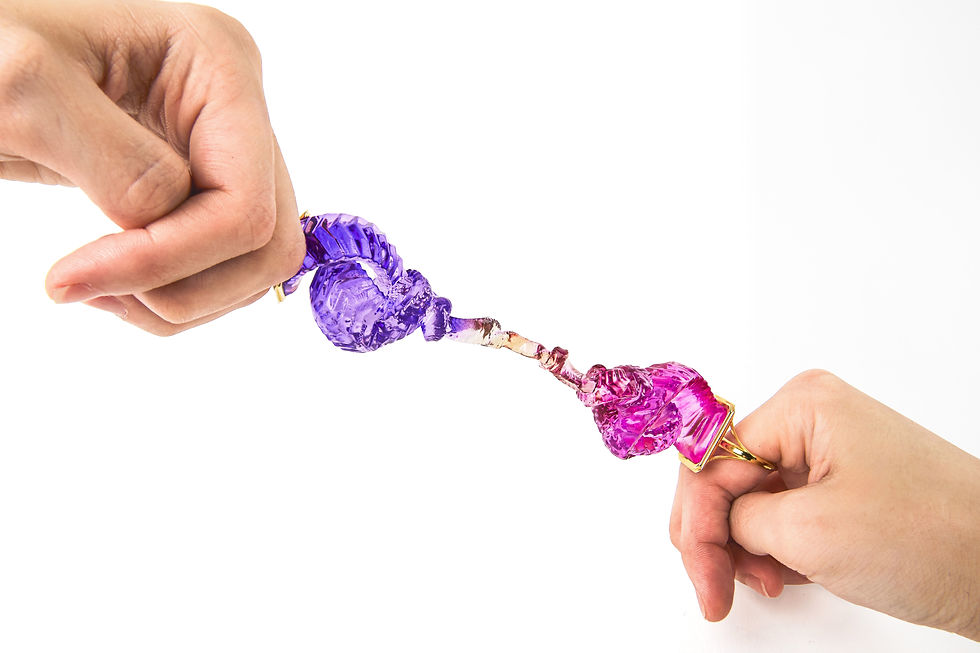
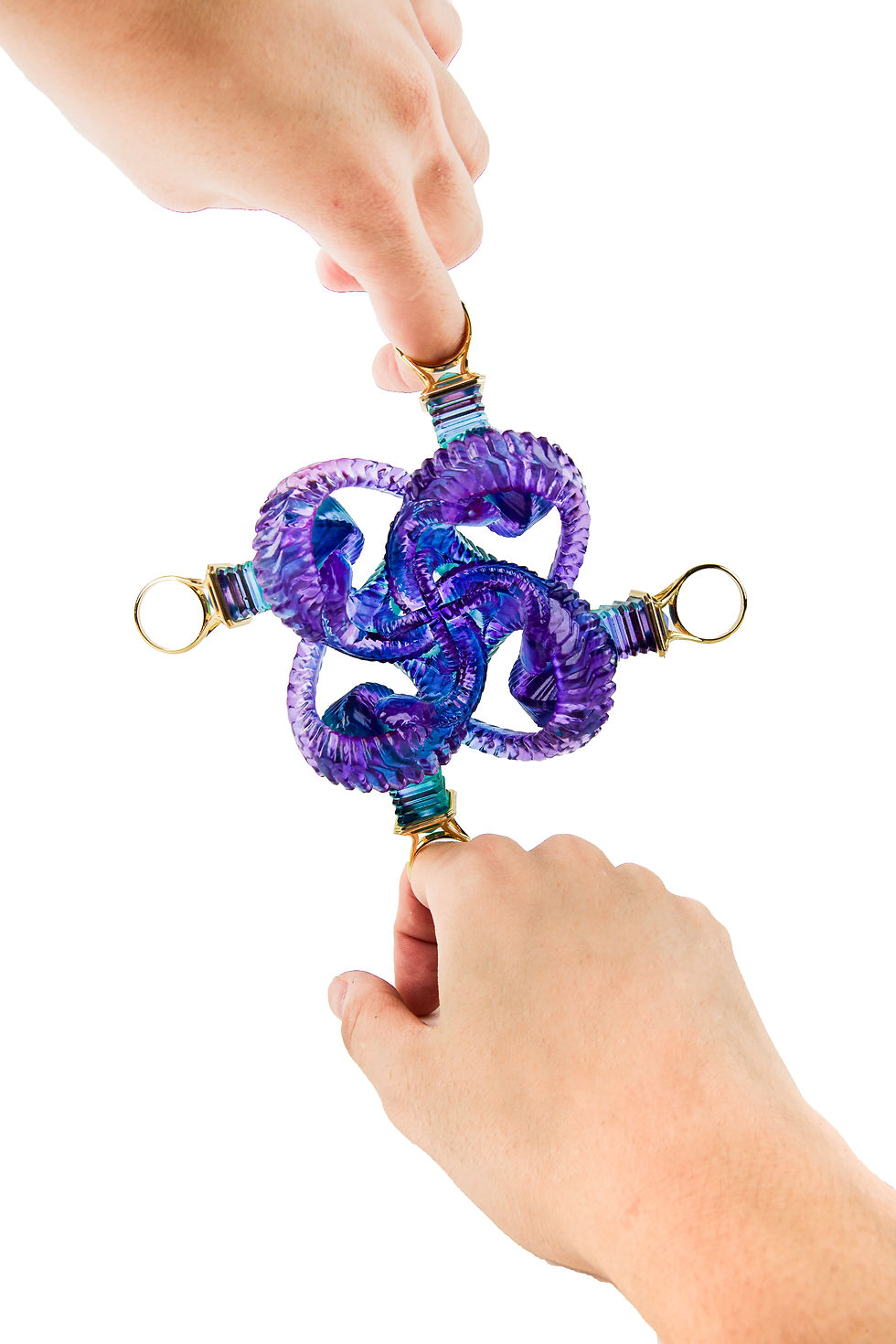
Almost everything I make comes back to one question: what does it mean to be in relation to someone? My signature body of work, <This Relationship Is>, is a series of rings that can only be worn simultaneously by two people. They interlock, and the pieces are physically incomplete without another body. The starting point was my relationship with my sister, but the painting that kept appearing in my mind was Portrait of Gabrielle d'Estrées and Her Sister, two women, one reaching toward the other, an intimacy that is tender and also slightly strange. I find that ambiguity interesting. The space between closeness and separateness.
My other major work, Face Face Face, is a brass sculpture made up of hundreds of small cast faces. It came from a different question, not who we are in relation to others, but who we are to ourselves. How many versions of a face do you have? Which one is the real one? Both bodies of work live in the same territory: identity, multiplicity, the self as something that only becomes visible through another.
4. How does your art life impact other parts of your life?
I think it's made me a more attentive person, though not always in comfortable ways. When your work is fundamentally about relationships, you start noticing them everywhere, the small negotiations, the moments of connection and misreading, the things that go unsaid. My sister and I are closer because of this work, I think, but also more conscious of each other in a way that can feel tender and a little exposing at the same time.
Living between Seoul and London has become part of my practice too, even when I didn't intend it to be. The feeling of being between places, of not fully belonging in either, has fed directly into my interest in thresholds and ambiguity. I'm not sure which came first anymore, the work or the life.
5. Could you share any difficulties and hardships you had to face in life and how or if you managed/overcame them?
Being an artist without a fixed base is something I'm still navigating. I've spent years moving between Seoul and London, which sounds romantic but often feels more like being slightly out of place in both cities at once. Building a practice while also figuring out visas, shipping logistics, applications, and rejections, it's a lot of administrative weight to carry alongside the actual making.
I've applied for residencies and programmes that I didn't get into. One in particular, I had prepared carefully, genuinely hoped for it, and the rejection stung. But the feedback was warm, and that mattered. I've learned to take those moments less as doors closing and more as information about timing.
The harder thing, honestly, is the financial uncertainty. Craft doesn't have a clear market the way some art forms do, and jewellery that asks something of its wearer, conceptual, relational work, takes longer to find its audience. I'm still finding mine.
6. Tell us about your best experience in the art world so far.
Being a SCHMUCK finalist at Munich Jewellery Week was significant. SCHMUCK is one of the most important platforms for contemporary jewellery internationally, and showing there placed my work in a conversation I had long admired from a distance. Receiving both a Silver and Bronze award from the Goldsmiths' Craft & Design Council around that same period added something else, a sense that the technical rigour I'd invested in the work was being seen, not just the concept behind it. For work that lives at the intersection of idea and making, that recognition meant a lot.
But what I remember most from all of it wasn't the awards themselves. It was the conversations I had around these moments, with jewellers and curators from all over the world who were thinking about the same questions I was. That sense of finding your people. That was the real thing.
7. Share your worst experience in the art world.
Shipping. I say that partly with humour and partly with complete sincerity. When you work internationally, so much of what you've made and care about ends up in a box, in transit, and you have very little control over what happens to it. I've had pieces delayed, held at customs, and returned without explanation. Each time, there's a particular kind of dread that comes from knowing that the object isn't just an object; it took months, it's irreplaceable in the way handmade things are.
Beyond logistics, there have been moments of feeling genuinely misunderstood, where the relational premise of the work was flattened into something decorative or simply novelty. That's harder to sit with than a bad shipping experience, because it touches the work itself. I've learned that not every context is the right context, and that finding the right audience is its own slow, ongoing practice.
8. What practical advice can you give to fellow artists?
Get comfortable with writing about your work, even if it feels unnatural at first. Not in a way that over-explains, but in a way that opens a door for someone else to walk through. The work doesn't speak entirely for itself, especially when it's conceptual. You are also part of the communication.
And keep records of everything, applications, correspondences, and the evolution of a piece across different stages. Not for nostalgia, but because your practice develops in ways that are hard to see while you're inside it. Looking back at old documentation has surprised me more than once.
Lastly, find the people who ask you real questions about what you're doing. Not just compliments. The conversations that push back a little, that make you articulate something you hadn't quite put into words yet. Those are the ones that move the work forward.
9. Is the artist life lonely? Please share your thoughts and experiences.
Yes and no. The making itself can be very solitary, long hours at the bench, a lot of time with your own thoughts. And when your work is conceptually driven, there's also a loneliness in not always being understood immediately. You spend so much time in your own interior that sometimes you forget to come back out.
But jewellery, particularly the kind I make, keeps pulling me toward other people. <This Relationship Is > literally cannot exist without another person. There's something in that which feels like an answer to the loneliness. I built the remedy into the work itself.
10. What are you working on at the moment, and are there any upcoming events you would like to talk about?
I've recently been working on new pieces within the This Relationship Is series, and I'm preparing to present them as part of the FRAGILITY exhibition, which will be shown at the Grimaldi Castle Museum in Cagnes-sur-Mer this June, during the Jewellery Week at Cagnes. The opening is on June 5th, and I'm genuinely looking forward to it. There's something fitting about showing work about fragility and relationality in a castle, in a city I've never shown in before.
The new work continues to explore interdependence as its core premise, but I'm pushing the series into territory I haven't fully resolved yet, which is where I tend to find the most interesting things. I'm sitting with the question of how far a relational object can travel from its origin and still carry the same weight.
the moment.
Instagram: https://www.instagram.com/_dd___k/
Website: https://www.dayekim.uk/


