


From Memory to Motion: Anand Manchiraju’s Journey Through Landscape and Imagination
- Anand Manchiraju
- Apr 27
- 5 min read
Interview with Anand Manchiraju
1. Please tell us something about your background and your art journey so far.
My artistic journey began in childhood under the quiet yet profound influence of my father, a renowned artist whose studio was my first school. I spent countless hours watching him work—the discipline of his hand, the silence of concentration, the mystery of an image emerging from the canvas. When he set down his brushes, I would pick them up and continue in my own way. Those early experiences taught me not only technique, but a way of seeing the world with sensitivity and wonder.

That immersion shaped my belief that art is not separate from life, but a way of living. This instinctive passion later led me to formally study photography at JNTU, Hyderabad, where I expanded my visual language and developed an openness toward experimentation. Throughout my career, including my years as an Artist Executive at IDPL, Rishikesh, I continued exploring diverse materials and unconventional processes—from photographic chemicals on bromide paper to reprocessed X-ray films, from expressive landscapes to abstract compositions.
Experimentation has always been central to my philosophy. I have never wanted to be confined by a single method or medium; instead, I see each artwork as an inquiry, a discovery. My journey has been guided by observation, curiosity, and a willingness to take risks while remaining rooted in tradition. I feel fortunate to have transformed a childhood calling into a lifelong vocation, and that sense of wonder continues to animate my work today.
2. Describe what a normal day looks like as an artist.
A normal day for me begins with observation and inward quiet. I see the artist’s day not merely as hours spent painting, but as a continuous rhythm of looking, reflecting, imagining, and creating. Spirituality plays a significant role in this rhythm. It sharpens focus, strengthens willpower, and sustains the discipline needed for artistic practice. For me, studio work and inner contemplation are deeply connected.
Daily life itself becomes part of the studio. A passing light, a memory, a conversation, or a movement in nature may trigger an idea. Some days are devoted to drawing, developing compositions, or working through textures and layers; other days are spent experimenting with materials or simply allowing ideas to mature before they enter the canvas.
For me, a normal day as an artist is not governed by routine alone, but by attentiveness—where discipline, experimentation, and inner reflection continually feed one another.

3. Can you tell us more about the theme in your art and your inspiration?
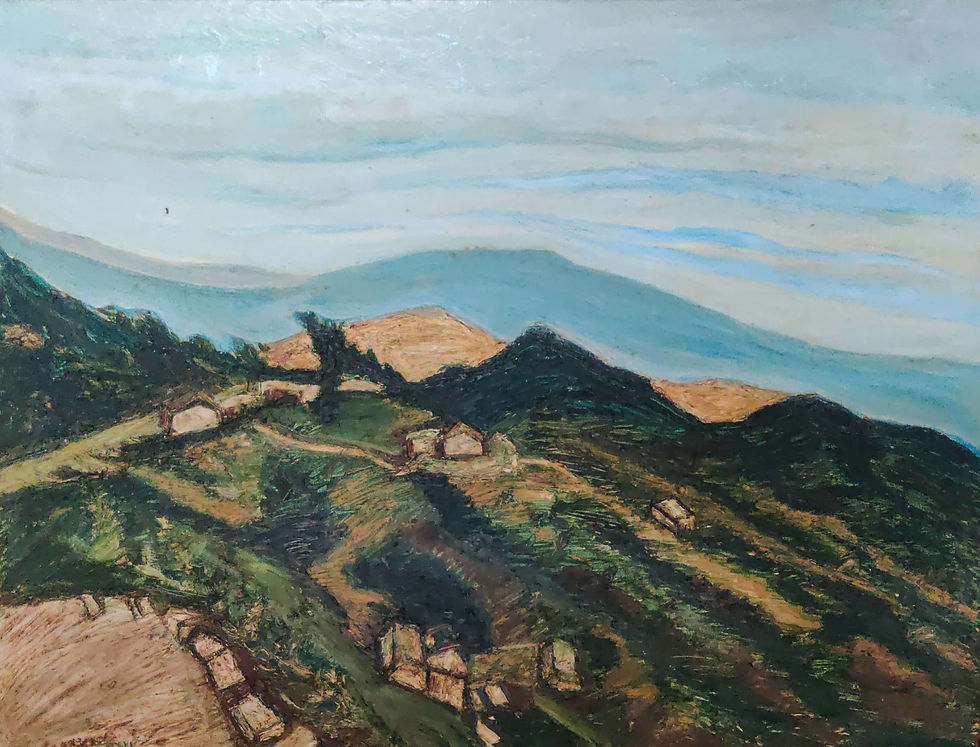
My work draws inspiration from what I often describe as everything that exists between earth and sky. I do not limit myself to one fixed subject, because inspiration can arise from countless sources—mountains, rivers, city rhythms, human emotions, spiritual thought, or fleeting moments of light.
There is often a dialogue in my work between the visible and the invisible. Sometimes this emerges through abstract cityscapes shaped by architecture, movement, and reflections; at other times through landscapes infused with memory and spiritual presence. Nature has always been a profound source, but so has the human condition—its energies, silences, struggles, and joys.
What interests me is transformation: how observation becomes emotion, and emotion becomes form, texture, and color. I often approach a painting intuitively, allowing the subject to reveal itself through the process rather than imposing a rigid concept from the beginning.
My inspiration also comes from experimentation itself. Whether working with palette knives, unconventional tools, or varied surfaces, I am drawn to the unexpected discoveries that emerge in the act of making. That openness keeps the work alive. For me, art is an ongoing conversation with the world—poetic, exploratory, and always evolving.

4. Tell us about your best experience in the art world so far.
Some of my most rewarding experiences in the art world have come through moments when experimentation led to discovery. For me, the greatest experiences have not been defined by a single exhibition or recognition alone, but by those transformative points in practice when a new visual language reveals itself.
One such continuing experience has been the freedom to translate vastly different inspirations—from the serenity of the Himalayas and the spiritual flow of the Ganges to the energy of urban skylines—into distinct bodies of work. Each series has expanded my understanding of what painting can become.
Working with unconventional tools such as palette knives, coconut leaves, and broomsticks has often introduced unpredictability into the process, and many of my most satisfying works have emerged from embracing that uncertainty. There is a special joy when a painting begins to evolve beyond one’s expectations and arrives at something unforeseen yet deeply authentic.
Another meaningful experience has been engaging with audiences internationally, where viewers bring their own interpretations to the work. Those encounters remind me that art has a life beyond the studio.
Ultimately, my best experience in the art world has been the continuing experience of exploration itself—the sense that each canvas can still lead me somewhere new.

5. What practical advice can you give to fellow artists?
My first advice to fellow artists is simple: work every day—not only with the hand, but with the mind and imagination. Drawing, reflecting, observing, studying, and nurturing ideas are all part of practice. Inspiration favors those who remain engaged.
It is also important to learn from the great masters—artists such as Pablo Picasso, Vincent van Gogh, and M. F. Husain—not to imitate them, but to understand their courage, innovation, and commitment.
I would encourage artists not to become confined by a single formula. Growth comes through experimentation and responsiveness. Be open to new subjects, new materials, and even unexpected detours. Sometimes limitations themselves become the source of innovation.
At the same time, remain aware of the larger context in which art exists—its audience, its evolving cultural climate, and the realities of the art world. This awareness can strengthen rather than diminish creative authenticity.
Most importantly, cultivate patience. Artistic growth is not immediate; it deepens through sustained practice. Even after decades of work, I believe an artist must remain a student—curious, humble, and willing to reinvent.

6. What are you working on at the moment and are there any upcoming events you would like to talk about?
Currently I am exploring a body of work that seeks to inscribe nature into the human form, particularly through portraits and profiles of women. In these works, the figure is not separate from the landscape but becomes an extension of it—hair transforming into hills, the body flowering into gardens, and human presence merging with trees, sky, and living earth.
What interests me in this evolving direction is the poetic unity between humanity and nature. I see these works as meditations on harmony, growth, memory, and interconnectedness. Rather than treating portraiture and landscape as separate genres, I am interested in dissolving those boundaries and allowing one to inhabit the other. This is a direction I plan to continue exploring through future works in varied forms and interpretations.

Alongside this new series, I will be participating in international open calls and art competitions, which continue to provide exciting opportunities for dialogue and exposure. I invite viewers and collectors to follow my ongoing journey and upcoming events through Instagram, where I regularly share new works, exhibitions, and competition participations. For me, these current explorations feel like the beginning of a new chapter in my practice
Social Media: https://www.instagram.com/artistanandmanchiraju/


