


DWELLING: Rethinking the Meaning of Belonging in a World of Constant Change

Exhibition Review | DWELLING
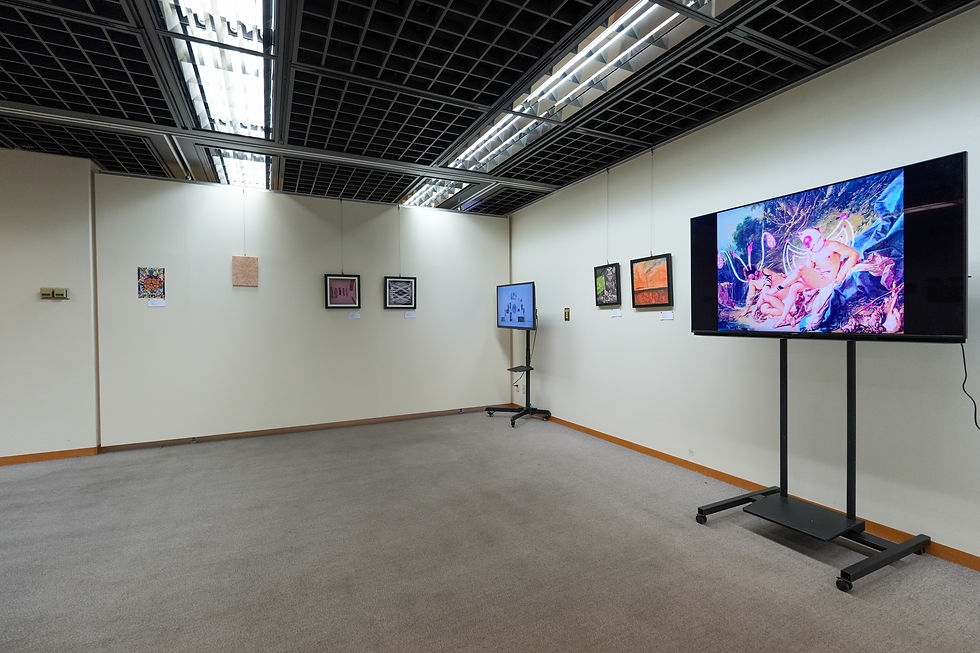
Held from 1 to 4 October 2026 at The Museum of Kyoto, Japan, DWELLING was an international group exhibition jointly organised by K:art Studio and 石西京アート事務所, and curated by Forrest Lin Wu. Bringing together over 60 artists from diverse cultural and artistic backgrounds, the exhibition presented a range of responses to the concept of dwelling, exploring its meanings beyond physical habitation.

Curatorial Concept: Reflections on the Origins of a Word
The word dwelling derives from the Old English dwellan, originally associated not with inhabiting a place, but with lingering, wandering, and delaying. Rather than suggesting the possession of a fixed space, its etymological origins evoke an ongoing process of engaging with the world and continuously forming relationships within it.
The association of dwelling with permanence, ownership, and stability has become deeply embedded in modern understandings of home. Yet in an era increasingly shaped by migration, mobility, and global interconnectedness, these assumptions invite reconsideration. How do we inhabit a world defined by constant transformation? And how might we learn to coexist with change itself?
Through this conceptual framework, DWELLING approached habitation not as a static condition, but as a dynamic relationship between individuals, their surroundings, and the shifting circumstances of contemporary life.

I. Defining Home: Lin Tian, The Shape of Home
One of the exhibition's most direct explorations of this theme appeared in Lin Tian's moving-image work The Shape of Home, inspired by the artist's personal experiences of repeatedly relocating and establishing a sense of belonging in unfamiliar environments.
The film begins with an unoccupied domestic interior. A bed, a book, and a lamp are enough to evoke the familiar image of a home. As the sequence unfolds in reverse, however, furniture, walls, and spatial boundaries gradually disappear. The home is progressively dismantled until only a solitary figure remains, before the image recedes further into an expanse of land.
Rather than offering a definitive answer to what constitutes a home, the work confronts viewers with a fundamental question: What truly makes a place feel like home? Is it the physical environment that surrounds us, or the memories, experiences, and relationships we form within it?
By stripping away the material components of domestic space, The Shape of Home reveals the less tangible dimensions of belonging, suggesting that home may exist beyond the structures that traditionally define it.

II. What Must Be Protected: Angel Wagner, The Unicorn Rests In The Community Garden
Moving from the physical construction of home towards the preservation of an inner world, Angel Wagner's oil painting The Unicorn Rests In The Community Garden situates dwelling within a more metaphysical and emotional framework.
An artist whose practice consistently seeks to affirm, empower, and celebrate women, Wagner reflects in this work on the conditions of dwelling in Minneapolis during the winter of 2026. Beyond its geographical context, the painting addresses the values that must be safeguarded within any place we call home: dreams, freedom, and the communities and support systems that sustain us.
In this interpretation, dwelling is never merely a matter of finding somewhere to settle. It also involves preserving what gives life meaning, even as external circumstances continue to shift.
Wagner's work suggests that the possibility of belonging depends not only on the security of a physical environment, but also on our capacity to protect the emotional and spiritual foundations through which we understand ourselves.

III. The Wilderness Reshaped by Economics: Chih-Fen Tsai, Luscious Sites-2
Chih-Fen Tsai's Luscious Sites-2 expands the discussion beyond domestic and psychological spaces, examining the increasingly complex relationship between human activity and the environment.
Employing defamiliarisation as a central artistic strategy, Tsai challenges established perceptions of how individuals interact with their surroundings.
In this digital illustration, rapid economic development and globalisation destabilise conventional notions of a permanent dwelling place. Nature is no longer presented as an untouched, idealised wilderness existing independently of humanity. Instead, it emerges as a hybrid landscape deeply entangled with cultural infrastructure, social systems, and economic activity.
The environment is therefore not simply an external backdrop against which human life unfolds. Rather, it becomes a continuously evolving system shaped by interactions between human actions and non-human forces.
Through this process of visual estrangement, Luscious Sites-2 invites viewers to reconsider the conditions of inhabitation itself, revealing how the relationship between humanity and nature has fundamentally transformed the ways in which we dwell.

From the Individual to the Relational: Expanding the Meaning of Dwelling
Together, these three works approach dwelling through distinct yet interconnected perspectives: the traces of everyday life, the protection of one's inner world, and the reciprocal relationship between humanity and the environment.
Each points towards a shared understanding: dwelling is not a fixed state, but an ongoing negotiation between individuals and the world around them.
Other works in the exhibition extend this exploration further.
In The Breath of Space, Aria Artis employs curves, layered forms, and a suspended circle to evoke a spatial structure sustained by invisible relationships. Rather than treating space as a fixed container, the work suggests a dynamic field of tensions and connections, in which dwelling emerges through movement and interaction.
Joanna Gołdowska's Musings approaches the subject through a quieter, more introspective perspective, contemplating a space that exists only in between, between breath and silence. Here, dwelling becomes less a question of physical location than an awareness of the subtle intervals through which existence is experienced.

Hollyana Melear's Birth and Death of Austin shifts the scale from personal experience to the transformation of an entire city. Drawing upon proportions reminiscent of religious iconography, the work juxtaposes buildings that have appeared and disappeared across Austin's urban landscape. It responds to the city's dramatic transformation over the past two decades, shaped by population growth and technological development.
Within this context, settling becomes an inherently temporary condition, an attempt to preserve the memory of a place before its next transformation.
Meanwhile, Kaellys' Kitsune Gateway explores the boundaries between visible and invisible realities. Through double exposure, an inverted world appears reflected upon the surface of water, while a fox mask marks the threshold between the human and spiritual realms.
The work proposes that dwelling does not necessarily involve inhabiting a single, coherent reality. Instead, it may emerge through moments in which different worlds overlap, allowing individuals to recognise their place within multiple dimensions of experience.
Across these diverse approaches, the exhibition expands the meaning of dwelling beyond geographical location, positioning it within a broader network of memories, perceptions, cultural narratives, and relationships.

Conclusion: Dwelling as an Unfinished Process
From the material presence of a room to the uncertain boundaries between reality and imagination, DWELLING unfolds the meaning of its title through a series of interconnected artistic perspectives.
Rather than presenting dwelling as possession or arrival, the exhibition understands it as a recurring act of remaining, a continuous process of negotiating one's relationship with the world.
When change becomes a defining condition of contemporary existence, the meaning of dwelling can no longer be secured solely through walls, addresses, or geographical boundaries. Instead, it is shaped by the traces we leave behind, the values we choose to preserve, and the relationships we continually establish with others and our surroundings.
Perhaps we never truly settle. We simply continue, again and again, to dwell.
Exhibition Information
Exhibition Title: DWELLING
Dates: 1–4 October 2026
Venue: The Museum of Kyoto, Japan
Curator: Forrest Lin Wu
Organisers: K:art Studio and 石西京アート事務所
Participating Artists:
Alexia KTD, Andrea Ehret, Ang Wu, Angel Wagner, Anna De Jesús Lugo, Anna Novakov, Aria Artis, Belinha Silva, Bianca Turner, BLACKWBLONDE, Chih-Fen Tsai, Chuanqi Hu, David Russell, Dorothea Ney, Dorothée Zombronner, Dragan Marković Markus, Emma Coyle, Esther Wiederhold, Fia Metta, Forrest Lin Wu, Gabrielė Kuizinaitė, Gaojie Chen, Guo Cheng, Hariclia Michailidou, Hollyana Melear, Jennie L., Joanna Gołdowska, Kaellys, Keren He, Kerrigan Reyes, Kexin Zhang, Krisztina Lazar, Lea Laboy, Lena Goral, Liba Waring Stambollion, Lin Tian, Luca Ripamonti, Luciano Caggianello, Marc D. Lariviere, Marianna Grant, Matthew Morpheus, Maura Glines, Megumi Ohata, Meici Zhao, Michell Osman, Nancy Mercado, Olivia O'Callaghan, Paris Kyrtatas, Ruocheng Zhou, séraphine, Shaoming Quan, Shayne Brantley, Tingwei Chang, Uzomah Ugwu, Vanessa Wenwieser, Victoria Yuanli Yuan, Xi Huang, Xingxuan Wang, Yucen Liu, Yuange Sheng, Yuliya Greben, Zsuzsanna Ursprung.

Acknowledgements
The organisers would like to express their sincere gratitude to the following organisations for their support of the exhibition:
Kyoto Prefecture
Kyoto City International Foundation
KBS Kyoto
The Kyoto Shimbun
Kansai Chinese Times
Goddessarts Magazine


