


Protocolized Life: Digital Assets and the Reconfiguration of Survival in Yucen’s Work

In an age increasingly governed by invisible infrastructures, the question of what sustains life is no longer confined to biology. London-based artist and researcher Yucen approaches this condition not as speculative fiction but as a quietly unfolding reality. Working across installation, moving image, and system-based practices, Yucen’s work examines how contemporary technological environments transform survival into something operational: monitored, evaluated, and maintained through computational logic rather than lived autonomy.
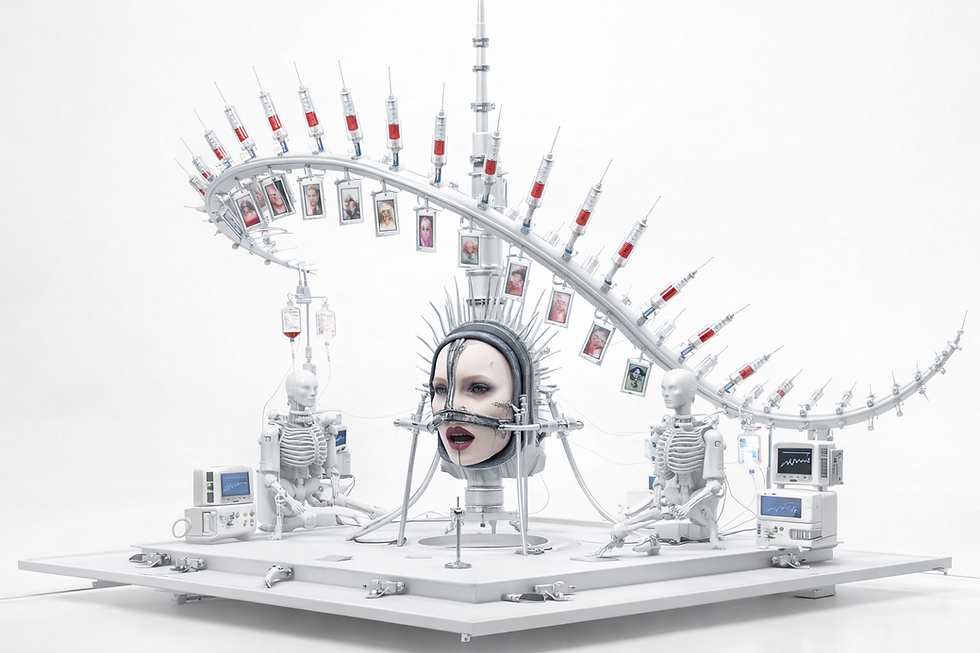
Currently studying at the University of the Arts London, Yucen situates his practice within the expanding field of Creative Research and Development (Creative R&D). His work draws from medical technologies, algorithmic governance, and computational infrastructures, treating them not simply as references but as structural frameworks through which life is increasingly organized. What emerges is a body of work that resists spectacle and instead exposes the subtle bureaucracies of survival embedded within technological systems.
At the centre of Yucen’s practice is the concept of digital assets, reframed as infrastructures that regulate existence itself. Within contemporary medical and technological environments, data records, monitoring systems, and predictive algorithms no longer function as supporting tools. They operate as threshold mechanisms, determining access, continuity, and termination. In Yucen’s installations, these systems appear as partially opaque structures that operate continuously without offering interpretative clarity. Their persistent presence evokes institutional authority while deliberately diminishing individual subjectivity.

Material (2023): Medical Memory and Material Resistance
The work Material (2023) offers one of the most intimate entry points into Yucen’s wider investigation. Composed of digital images that reimagine Western medical equipment alongside traditional Chinese medicinal materials, the work originates in the artist’s own experience of medical anxiety. Over one thousand doses of herbal prescription residue — substances that once circulated within the artist’s body — are transformed into sculptural surfaces resembling geological strata. These hardened residues operate simultaneously as archive and testimony, materializing bodily memory through sedimented time.

Rather than dramatizing trauma, Yucen presents the medical encounter as an ambient condition, evoked through metallic atmospheres and clinical references that subtly recall the experience of being observed under institutional scrutiny. The body within these images does not perform recovery or suffering; it remains suspended within a state of quiet endurance. This refusal of performative vulnerability becomes a form of resistance, challenging dominant narratives that frame medical intervention as inherently restorative or heroic. Instead, the work suggests that medical systems can also produce layered psychological and sensory residues that persist long after treatment concludes.
Protocolized Entry and the Architecture of Managed Life
Expanding beyond personal memory, Yucen’s broader research examines how technological systems restructure the very beginning of life. In Protocolized Entry Point, an infant body is depicted as existing entirely within a regime of monitoring and admission. The interface connected to the chest functions not as a healing device but as a technical gateway through which life becomes eligible for continuation. Birth is displaced by system access; existence begins not with biological emergence but with successful enrolment into monitoring infrastructure.

This conceptual repositioning reflects Yucen’s wider proposition that survival has become a procedural event. Within these works, digital assets do not appear visually as data or interfaces. Instead, they manifest as underlying conditions that silently determine whether life remains operational. The absence of overt technological spectacle is crucial: by withholding legible function, Yucen emphasizes the opacity through which contemporary systems exercise authority.
Distributed Maintenance and the Fragmented Body
In Distributed Maintenance Architecture, the body undergoes further transformation, becoming a networked infrastructure sustained through modular nodes aligned along the spine. These components do not correspond to identifiable neurological functions. Instead, they resemble interchangeable maintenance units connected through cable systems, suggesting a distributed life-support mechanism in which the body is no longer treated as an integrated whole but as a series of serviceable parts.
Health within this structure is no longer experienced subjectively. It is determined by whether operational nodes remain active. Individual existence is translated into a runtime condition, sustained through ongoing system continuity. The body’s coherence gradually dissolves, replaced by an architecture of maintenance that privileges functionality over experience.


Load, Suspension, and Assetized Existence
Yucen extends this investigation through images such as Non-Performative Body under System Load, where the body adopts a posture of lowered gaze and suspended movement. Here, technological apparatuses neither empower nor coerce. They attach to the body quietly, sustaining it through uninterrupted operation. Survival is framed not as progress but as managed suspension — life maintained within a state of default continuation.
In Assetized Life under Continuous Evaluation, this condition reaches its most explicit articulation. Transparent thoracic modules and restraining interfaces render the body entirely visible to systemic assessment. Life becomes an assetized entity whose value derives not from consciousness or experience but from compliance with operational conditions. The apparatus offers no therapeutic promise or endpoint. Its presence simply declares that life continues only through ongoing evaluation.
The Lifecycle of Survival Protocols
Across these works, Yucen constructs a conceptual lifecycle of survival composed of entry, maintenance, load, and evaluation. Each stage reveals a progressive displacement of life as an autonomous phenomenon. Instead of serving human existence, systems begin to treat life as a variable within their own continuity. Survival becomes less an ethical commitment than a computational outcome.
What makes Yucen’s practice particularly compelling is its refusal of dystopian sensationalism. The installations and images operate with clinical restraint, mirroring the quiet authority of the infrastructures they examine. Familiar medical aesthetics are rendered slightly illegible, encouraging viewers to confront their own dependence on systems that remain largely invisible yet profoundly consequential.


Reconfiguring the Politics of Survival
Yucen’s work ultimately asks a disquieting question: when technological systems become the primary agents responsible for sustaining life, what happens to the meaning of living itself? By translating medical and computational infrastructures into aesthetic and conceptual frameworks, Yucen reveals survival as a negotiated condition shaped by protocols, thresholds, and operational continuity.
In doing so, the artist offers a critical lens through which contemporary audiences can reconsider the subtle transformation of care, autonomy, and vulnerability in technologically mediated societies. Yucen’s practice does not propose solutions or alternatives. Instead, it exposes the infrastructures that quietly sustain modern existence, inviting viewers to reflect on how life is increasingly measured not by experience, but by whether systems continue to run.
Lena Snow
Editor and Founder, Goddessarts Magazine


